tl;dr: SP³ turns a Spherical Encoder into a fast generative prior for image restoration. It alternates stable manifold projections with closed-form data consistency, producing sharp results from the first iteration without computing gradients during inference.


SP³ overview. The method repeatedly projects an estimate through a Spherical Encoder prior and enforces agreement with the measured data. It achieves competitive perceptual quality while running substantially faster than existing comparable zero-shot methods.
Abstract
In this paper, we introduce SP³, a novel Plug-and-Play algorithm that accelerates maximum a posteriori image restoration by replacing denoisers with Spherical Encoders (SE) as generative priors. SP³ approximates the intractable proximal prior step by utilizing the SE tightly structured latent space as a robust projection onto the natural image manifold. Alternating this projection with a closed-form data-consistency step, via Half-Quadratic Splitting, achieves stable convergence without requiring gradient computation during inference. This unique formulation unlocks “anytime” restoration capabilities, producing sharp, plausible images from the first iteration. Evaluations across a variety of image restoration tasks demonstrate that SP³ achieves perceptual quality comparable to state-of-the-art zero-shot diffusion and flow methods while being - faster.
Why spherical priors?
Modern diffusion and flow priors produce strong restorations, but they are iterative and often require backpropagation through a large generative model at inference time. Spherical Encoders provide a different structure: they map images to a densely populated, bounded latent sphere and decode points on that sphere back to plausible images.
The full encoder-decoder therefore acts as a useful projection operator:
- It maps degraded, out-of-distribution inputs toward the natural-image manifold.
- Injecting latent noise stabilizes repeated projections and improves perceptual quality.
- Successive projections refine the image instead of catastrophically drifting, unlike the tested VAE baselines.

Spherical Encoder as a projection operator. Repeated SE projections rapidly improve perceptual quality and remain stable. Standard VAE encode-decode cycles instead drift away from the image manifold.
Why use both encoder and decoder?
Naive latent MAP baselines optimize only through the decoder. This discards the encoder, even though it was jointly trained to map images onto the structured spherical manifold.
SP³ uses the complete Spherical Encoder as its prior operator. In AFHQ deblurring, it improves PSNR, LPIPS, KID, and runtime over both spherical gradient descent baselines.
| Method | PSNR ↑ | LPIPS ↓ | KID ↓ | Time |
|---|---|---|---|---|
| S-GD | 18.5 | 0.58 | 34.3 | 1.32 s |
| S-PGD | 23.1 | 0.26 | 5.49 | 1.17 s |
| SP³ | 25.7 | 0.12 | 2.64 | 0.28 s |

Top: clean and degraded. Bottom: SP³, S-PGD, and S-GD. SP³ balances data consistency with high perceptual quality.
Plug-and-Play restoration
SP³ applies Half-Quadratic Splitting to alternate between the learned image prior and the known measurement model. Starting from an initialization derived from the degraded observation , each iteration performs four operations:
- Encode:
- Noisy spherify:
- Decode:
- Data consistency:
The data step has the closed-form solution
No differentiation or backpropagation is required during restoration.

Empirical convergence. Consecutive iterates rapidly stabilize across all six evaluated restoration tasks.
Restoration results
We evaluate SP³ on AFHQ-Cat at resolution and CelebA at resolution across six noisy inverse problems: box inpainting, denoising, super-resolution, deblurring, paintbrush inpainting, and random inpainting.
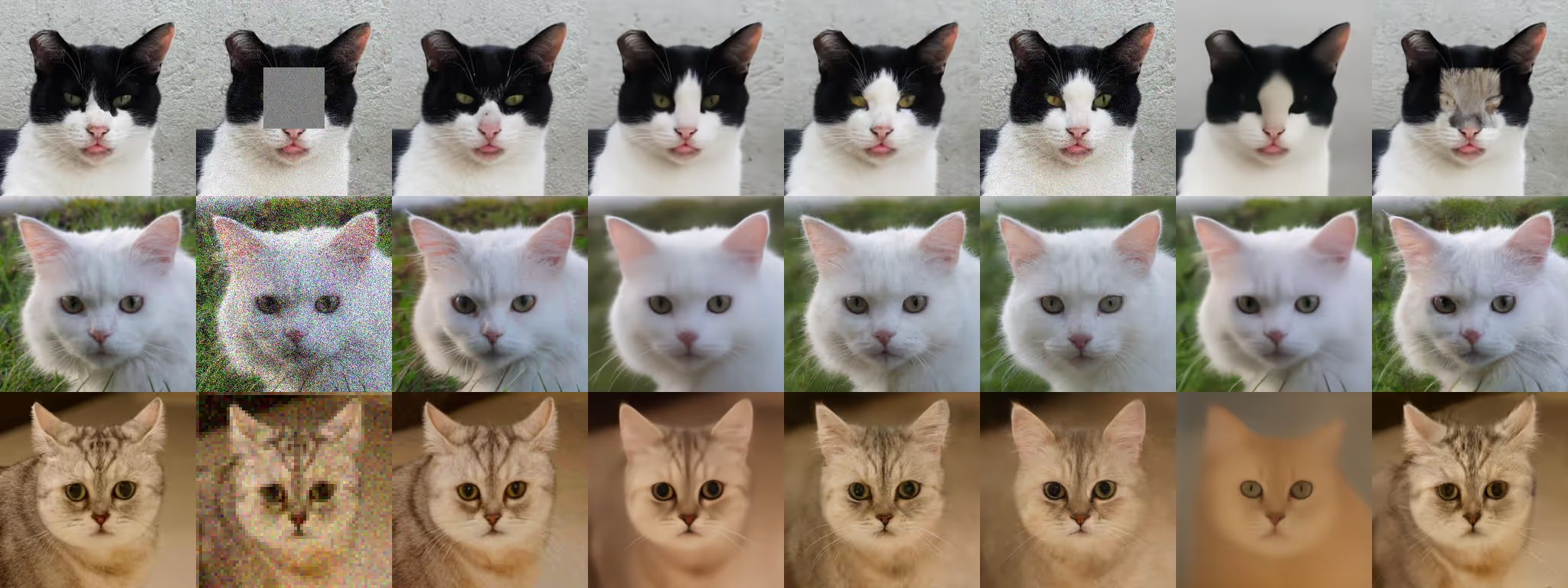 Qualitative results. Inpainting, denoising, and super-resolution.
 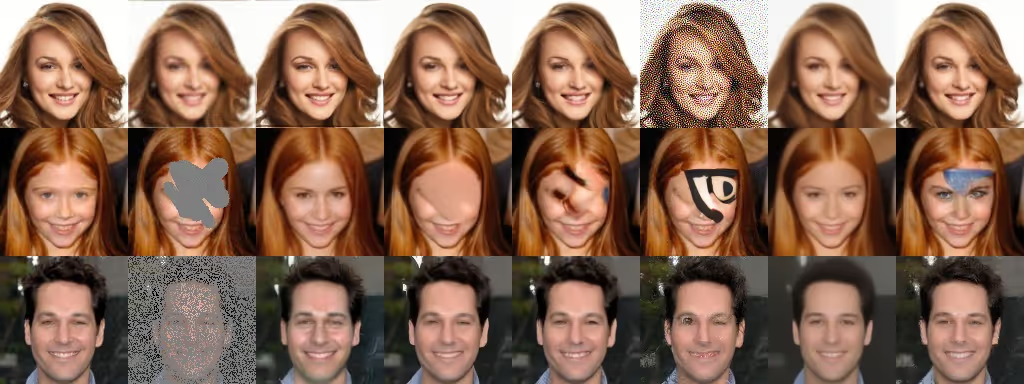 Qualitative results. Deblurring, paintbrush inpainting, and random inpainting.
Perception-distortion evaluation. SP³, shown as a red sphere, achieves perception-distortion tradeoffs comparable to the best competing zero-shot methods across AFHQ-Cat and CelebA.
Fast and anytime restoration
Because a single Spherical Encoder pass already projects the degraded input toward the natural-image manifold, SP³ produces a useful reconstruction after one step and can refine it for as long as the available time budget permits. With 20 steps, SP³ is approximately faster than OT-ODE and faster than DPS, its closest competitors in visual quality.

Quality versus runtime. SP³ points correspond to 1, 3, 5, 10, and 20 iterations.

Top: clean and degraded. Bottom: SP³ after 1, 3, and 5 steps.
BibTeX citation
@misc{man2026sp3,
title = {SP3: Spherical Priors for Plug-and-Play Restoration},
author = {Man, Sean and Raphaeli, Ron and Kleiner, Matan and Ronai, Or},
year = {2026},
note = {Preprint}
}